

We are excited to announce the launch of HYDRA: A Modular and Customisable Experimental Facility for Developing and Testing Smart Water Technologies project, which will create, in the Laboratory of Applied Hydraulics of NTUA, a modular and expandable circuit of pressurized pipes, accompanying with core physical and digital components of urban water systems. The infrastructure will allow the configuration of alternative network topologies, enabling benchmarking upon a wide range of operating conditions and scenarios.
HYDRA will the first infrastructure of this type in Greece, and one of the few in Europe, selected for funding by the H.F.R.I.s, under the 2nd Call for the procurement of High Value Research Equipment.
The current and future services of urban water infrastructures face a range of challenges in providing safe and reliable water to meet the needs of growing urban populations, including aging infrastructure, non-revenue water, climate stresses, contamination, cyber-physical threats and the continuous need for sustainable and resilient management practices. In this context, HYDRA attempts to be an innovation catalyst, supporting the development, calibration, testing and benchmarking of new smart hardware and software technologies, in experimental, though close to real-world, conditions. It aims to significantly enhance the existing academic, research and market opportunities for multiple stakeholders, both public and private. Furthermore, this experimental facility will enable stakeholders, such as water utilities and critical infrastructure management agencies, to demonstrate and validate the accuracy, efficiency, and applicability of new technologies before opting for integration into their daily business.
HYDRA goals:
- NTUA's undergraduate, graduate, and lifelong learning modules can be supported by practical experiences for young engineers
- innovative models and algorithms for water systems (e.g., based on machine learning and soft-sensors techniques) as well as digital services and applications
- new hardware and software solutions (such as third-party smart meters and/or water quality sensors) can be assessed and benchmarked to make them appropriate for real-world situations and guarantee the HYDRA infrastructure's financial viability.
HYDRA will consist of a modular and expandable circuit of pressurized pipes of the two core experimental arrangements, i.e., a looped (HYDRA-L) and a single-pass (HYDRA-SP) network, along with other physical components of a water system (e.g., storage and drainage tanks, pumps, isolation and outlet valves), which will allow the configuration of alternative network topologies and scales, under a wide range of operating conditions and real-world dynamic scenarios, at both spatial and temporal level.
In terms of operations, water in HYDRA will supplied by the main recirculating network of LoAH, and all outflows will be collected into the drainage tank which has a twofold operation;
a) store and re-circulate water to minimize consumption and
b) isolate volumes containing chemical or biological agents, to maximize safety and avoid their recirculation in the LoAH system. HYDRA-L serves as a distribution system emulator for domestic (small diameter pipes) and industrial intakes (larger diameter) at main and sub-main scales.
The facility can recreate multiple topologies and operational conditions, though the remotely controlled valves at each link and the feeding pumps, and accommodate different consumption levels (household, industrial etc.) and time varying demand patterns via the adjustable, remotely controlled outflow valves at each node.
The project kicks off on November 1, 2025 and its activities will extend for the next two years. Principal Investigator is Professor Christos Makropoulos. Host Institution is the School of Civil Engineering of National Technical University of Athens (NTUA).
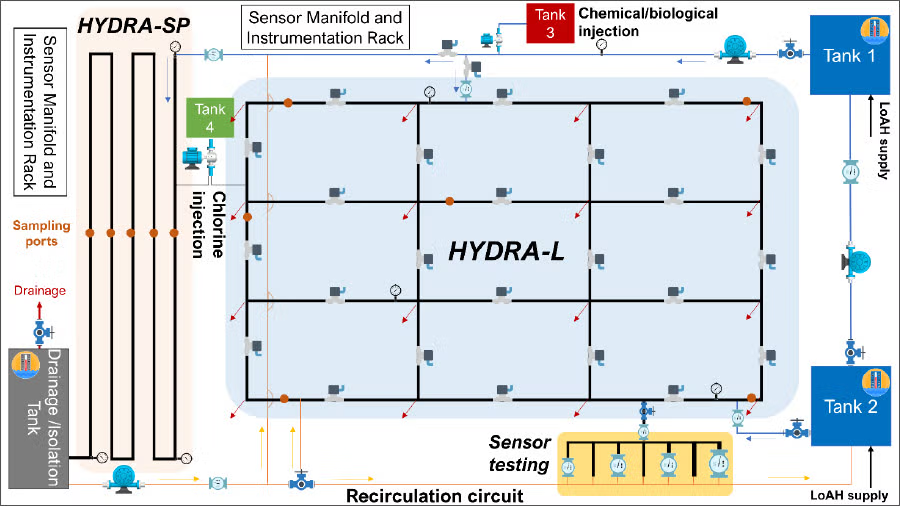
Conceptual design of the HYDRA experimental facility

The project entitled is implemented under the “2nd HFRI Call for the procurement of high-value research equipment” (H.F.R.I. Project Number: 18168).